
A child sees the small red mitten under the bench before the sentence ever mentions it. On the next spread, the words say that everyone has gone home—but the picture shows one set of footprints returning. The meaning lives in the distance between what is written and what is seen.
That is the essential promise of a picture book. The images are not optional decoration added after a complete story. They carry narrative information: setting, action, emotion, contradiction, rhythm, and sometimes the ending itself. The American Library Association’s Caldecott criteria describe a picture book as one that provides a visual experience and judge how pictorial interpretation advances the story, theme, or concept.
One story, two languages
Words are precise in some ways. They can name a fear, mark time, or let us hear a character’s private thought. Images are precise in others. They reveal distance, body language, color, scale, and the things a narrator may not notice.
When both channels repeat exactly the same information, the book can feel flat. “Maya was nervous” beside a picture that merely shows Maya looking nervous gives the reader one idea twice. The page becomes richer when the sentence tells us she has practiced all week while the image reveals her shoes pointing toward the exit.
A picture book is not text plus pictures. It is the meaning created when text, image, and page turn meet.
The page turn is an edit
A picture book controls time physically. The reader holds one spread, anticipates what comes next, and turns the page. That gesture can reveal a joke, widen the world, interrupt a quiet moment, or delay an answer. In cinematic terms, it works like a cut—but the reader performs it.
This makes pacing visible. A sequence of small panels can compress several actions. A full-bleed spread can slow time and let an emotional beat breathe. A nearly empty page can make absence feel enormous. White space is not unused space; it can be silence.
What the pictures are responsible for
Building the world
The illustrations establish where the character lives, how large the room feels, what season it is, and whether the world is welcoming or uncertain. Much of this need not be repeated in prose.
Directing attention
Composition tells the eye where to begin and how to move. Size, contrast, light, gaze, and gesture create a path through the spread. A tiny figure surrounded by sky does not communicate the same feeling as the same figure filling the frame.
Carrying the subplot
A background character may pursue a second story across several pages. An object can disappear, change hands, and return. Young readers often discover these visual threads before adults do, which turns rereading into investigation rather than repetition.
Making room for inference
Reading Rockets notes that wordless picture books invite children to interpret visual narratives, notice sequence, and construct language around what they see. Picture books with text can create the same kind of participation when they refuse to explain every detail.
A practical way to plan a picture book
Write the emotional change first
Before counting pages, define what changes. Perhaps a child who hides their drawings finally shares one. Perhaps two friends learn that helping is not the same as taking control. The external action should make that internal movement visible.
Build the sequence in spreads
Break the story into moments a reader can hold at once. Give each spread one dominant purpose: discovery, resistance, escalation, pause, reversal, or release. If two consecutive spreads do the same work, one may be unnecessary.
Assign information instead of duplicating it
For every spread, ask: what must the words tell us, and what can only the image show? Then ask what neither should state directly because the reader can infer it. This simple division often shortens the text and strengthens the art.
Test the book without its words
Look through rough thumbnails in silence. Can you follow the change of place, action, and emotion? Confusion at this stage is useful. It reveals missing visual information before finished art makes revision expensive.
Read it aloud at actual pace
A picture book is also a performance shared between people. Listen for breath, repetition, page-turn suspense, and places where the sentence fights the image. A line that looks elegant on a screen may feel heavy in a child’s ear.
Visual literacy begins with looking together
Adults do not have to explain every symbol. They can ask open questions: What did you notice first? What changed? How do you know the character is worried? What might be beyond the edge of the page?
Those questions treat the child as a reader of images, not only a listener waiting for printed words. They make space for evidence, interpretation, and disagreement. The book becomes a shared field of attention.
From picture book to CinemaBook
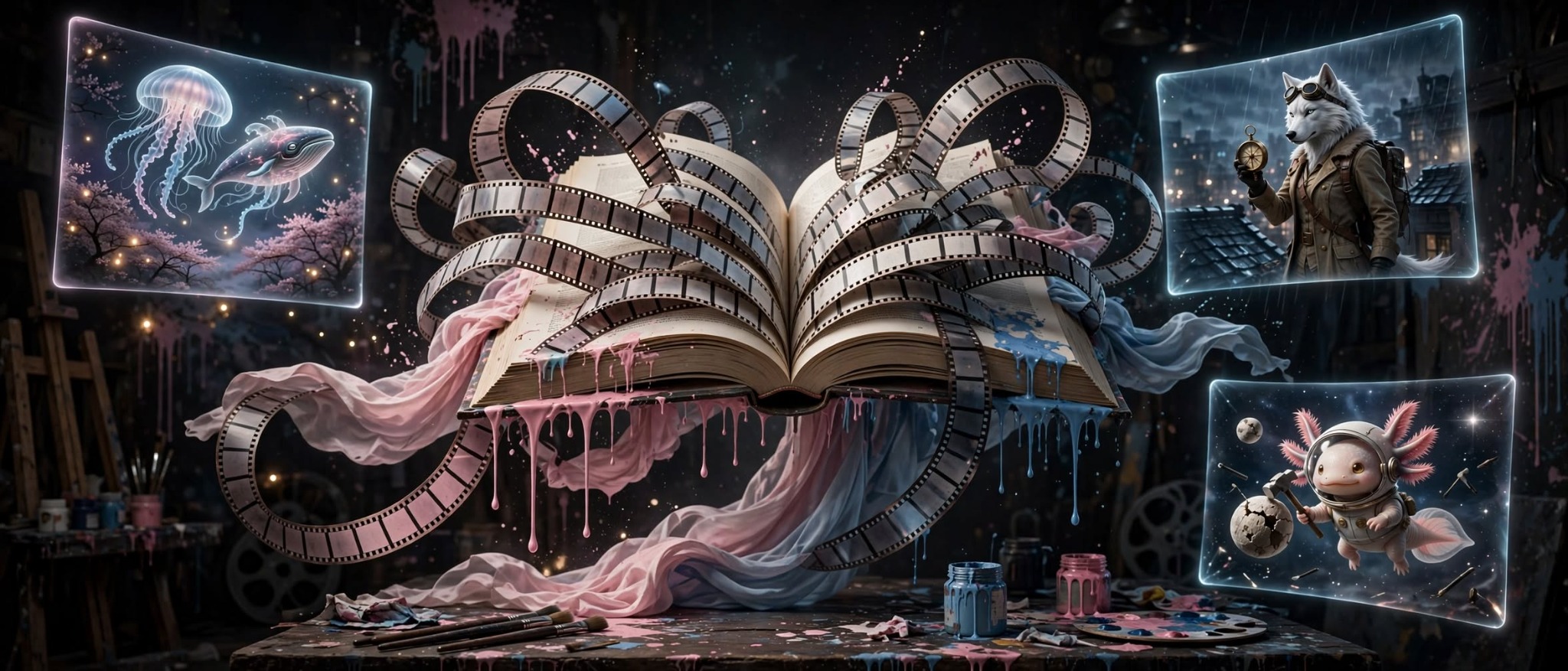
Manifesto’s CinemaBooks extend the same discipline: each spread has an emotional beat, a visual intention, and a relationship to what comes before and after. A cinematic image is not simply detailed or dramatic. It knows where the viewer stands, what must be noticed, and why the scene changes now.
The result can be quiet. It can be playful. It can contain only a handful of words. What makes it a picture book is not the amount of illustration. It is the inseparable design of seeing, reading, pausing, and turning the page.