
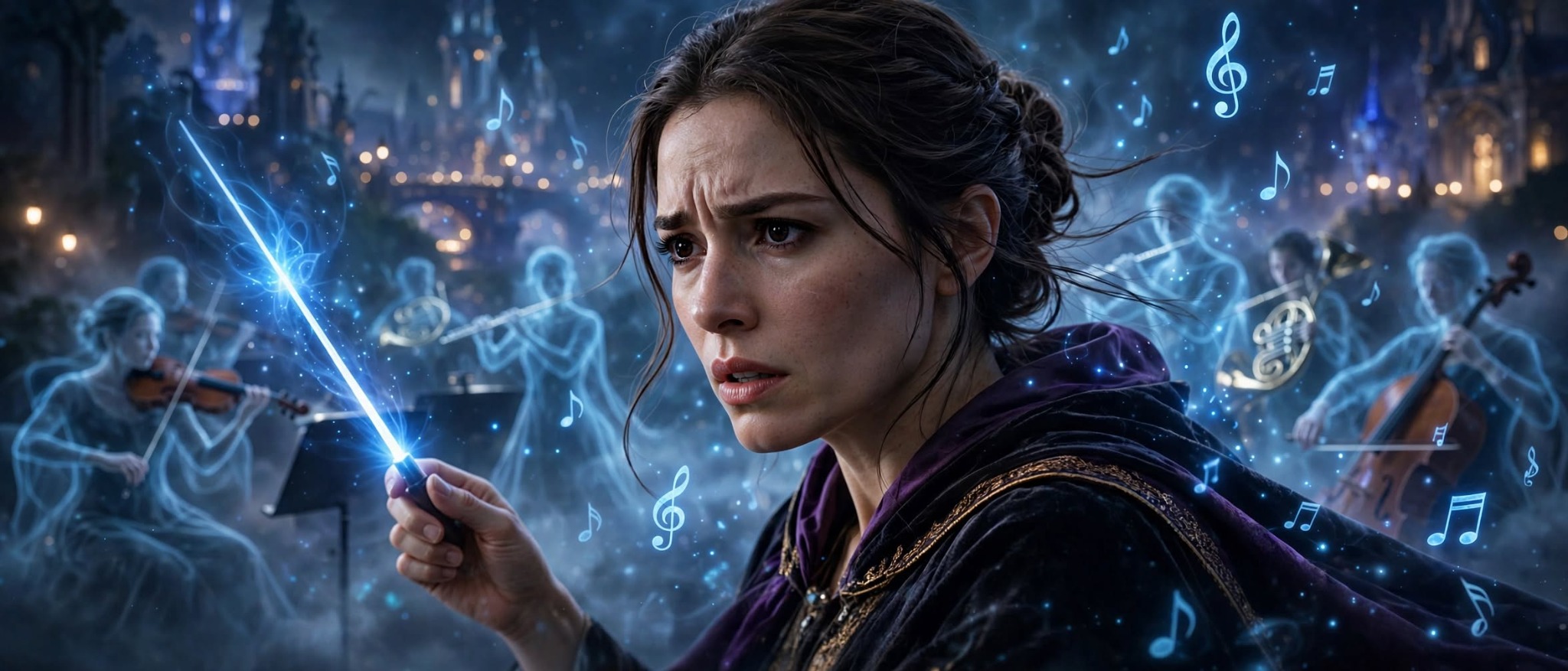
We hear the figure before the traveler opens the letter: a short rhythm, a rising leap, then one note held longer than expected. Hours later, the same shape returns under a different harmony. The notes are familiar, but what they mean has changed.
That is the narrative power of a character theme—or, more precisely, a leitmotif. It is a recurring musical idea associated with a person, place, relationship, object, or dramatic concept. Berklee’s film-scoring curriculum treats themes and their attribution as part of the score’s larger narrative system: music can shape character development and dramatic meaning, not simply decorate the picture.
The goal is not to write the catchiest tune in isolation. It is to create a musical identity flexible enough to tell the truth in more than one scene.
A motif is a seed, not the finished score
A motif may be only a few pitches, a distinctive interval, or a rhythmic gesture. A full theme usually develops more material around that seed. Film scores may use both, and creators often use the words loosely, but the distinction is useful: the smaller the core idea, the more easily it can travel through different scenes.
Test the motif away from its original production. Can you recognize it without the signature instrument? Does it still have a shape when played slowly, moved to another key, or reduced to a single line? If the identity disappears, the orchestration may be doing all the work.
A character theme should not tell us that someone has entered the frame. It should tell us what their presence means at this point in the story.
Begin with the dramatic contradiction
Before composing, describe the character without using genre or mood words:
- What do they pursue?
- What do they refuse to admit?
- What behavior protects them at the beginning?
- What will they have to risk by the end?
“Brave,” “mysterious,” and “epic” can produce attractive but interchangeable music. A more useful direction might be: “She maps every road because she cannot accept that some losses have no route back.” Now the motif has a tension to embody—precision against grief, forward motion against return.
Build a recognizable musical fingerprint
Choose a clear contour
Contour is the shape created as notes rise, fall, repeat, or leap. It can remain recognizable even when the exact pitches change. Draw the line on paper before you name the notes. Does it climb and collapse? Circle one pitch? Reach upward but stop short?
Give the rhythm a point of view
Rhythm can reveal impatience, restraint, ritual, or hesitation. A pause placed in the same spot may identify the character more strongly than a particular chord. Clap the phrase. If the rhythm has no identity without its sound palette, simplify it.
Find one interval worth protecting
A distinctive jump or neighboring motion can act as the motif’s hinge. It does not carry a fixed universal emotion; context teaches the audience what it means. Later, widening, narrowing, inverting, or withholding that interval gives the score a precise way to show change.
Treat timbre as characterization, not a costume
Instrument choice matters. A breathy woodwind, bowed metal, detuned piano, or intimate human voice can suggest a physical and emotional world. But timbre should be allowed to evolve. The theme may begin on a fragile solo instrument and end distributed across an ensemble because the character no longer carries the burden alone.
An original example: the mapmaker
Imagine an apprentice cartographer who secretly alters official maps to mark places erased after a flood. Her motif begins with a dotted rhythm and an upward fourth, followed by two quiet steps downward. The rhythm feels purposeful; the retreat hints that she still fears being seen.
At first, the phrase appears as pencil taps and muted plucked strings while she works after hours. When authorities discover the altered maps, the rising interval is buried in low brass but the rhythm becomes irregular. In the final sequence, the downward notes reverse direction and another instrument answers the phrase. The theme has not become “bigger” merely because the climax arrived. Its grammar changes because secrecy has become collective memory.
Write a transformation map
Berklee’s current composition coursework emphasizes developing and varying themes through melody, harmony, rhythm, and orchestration in support of character arcs. You can make that principle concrete by assigning the theme a job at each stage:
- Introduction: establish only the amount of identity the audience needs.
- Pressure: fragment, interrupt, reharmonize, or place the theme against another idea.
- Recognition: let the audience understand an earlier appearance differently.
- Choice: alter the motif at the moment the character acts, not only after the plot confirms the result.
- Aftermath: decide what remains when the old version of the character no longer fits.
Keep at least one anchor audible while changing the others. A familiar contour can survive a new harmony. A rhythm can remain while the melody is reduced to one pitch. Transformation feels earned when the listener can sense both continuity and difference.
Spot the silence, too
Film composers and directors use spotting sessions to decide where music should enter, leave, and stay absent. That question belongs in small independent productions as well. Do not place the theme under every appearance of the character. Constant confirmation turns meaning into a label.
Try three versions of a key scene: no score; the theme entering before the visual reveal; and the theme arriving only after the character makes a choice. Each version changes who seems to know what, and when. Sometimes silence protects the performance. Sometimes an incomplete motif lets the audience feel a truth the character cannot yet name.
A practical human-directed AI workflow
Generative music tools can produce fast variations, but speed can blur authorship and continuity. Establish the motif yourself first—in notation, MIDI, voice memo, or an instrument recording—and create a theme sheet with its dramatic purpose, invariant features, allowed transformations, tempo ranges, and instrumentation ideas.
Then give the tool bounded tasks. Ask for a texture that preserves the dotted rhythm and upward interval while removing harmonic resolution. Request three orchestration studies for the same eight bars. Compare the files against the story map and reject any result that replaces identity with generic scale.
Document source material, edits, licenses, and final human decisions. The technology may help explore options; the creator still decides when the motif appears, what it remembers, and why it changes.
Common mistakes
Writing “hero music” instead of this person’s music
Genre references can guide palette, but they do not define character. Return to the contradiction and remove any gesture that could be transferred unchanged to another protagonist.
Saving every variation for the climax
Character development happens throughout the story. Let small changes prepare the listener, so the final transformation feels inevitable rather than newly attached.
Making every cue prove the motif is there
A fragment, bass line, harmony, or rhythm may carry the association without quoting the complete melody. Trust the audience’s memory.
Polishing the mockup before testing the scene
A luxurious sound can hide a weak dramatic idea. Place a simple piano or single-line version against the edit first. If the timing and meaning work there, production can deepen them.
Music becomes story when it remembers
In Music Worlds, sound belongs to the identity of the world. In Film & Motion, it must also respect dialogue, editing, performance, and silence. The creative workflow can expand, but the dramatic question stays human: what should the audience recognize now that they could not understand before?
A strong character theme is not a logo made of notes. It is memory under pressure. It returns because the story returns to the same question—and it changes because the character no longer answers in the same way.